
The CM Practitioner’s Handbook
What the Standards Don’t Teach You
Configuration Management is one of the most important disciplines in complex engineering — and one of the least well served by its own literature. The standards describe the mechanism. Training focuses on compliance. Neither addresses what practitioners actually need to do the job well in difficult conditions.
The CM Practitioner's Handbook fills that gap. Written by a practitioner, for practitioners — it covers the competencies, judgement, and organisational skills that determine whether CM actually works in practice.
What’s Inside
-
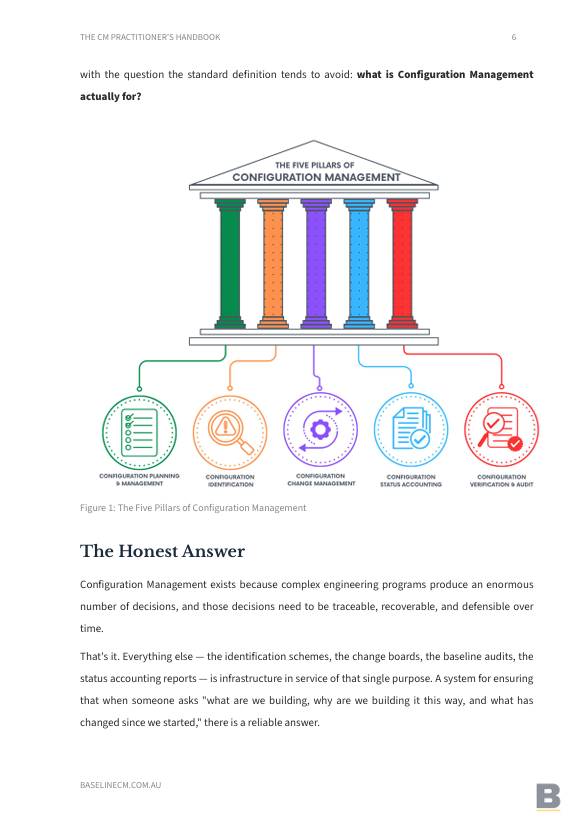
A reframing of the discipline — not as a documentation function, but as a governance function that exists to make program decisions traceable, recoverable, and defensible.
-
The five attributes that separate genuinely effective CM practitioners from merely compliant ones: resourcefulness, adaptability, problem solving, confidence, and organisational navigation. Each covered in depth with real scenarios, self-assessment prompts, and guidance for managers.
-
What baselines actually are, how to establish and maintain them, and how to recognise and recover from baseline drift — the most common and most damaging problem in complex programs.
-
The gap between change control on paper and change control in practice. How to design a process that makes genuine governance decisions, conduct real impact analysis, and run a CCB that actually catches problems.
-
How to maintain configuration integrity across fragmented digital tools, define and enforce sources of truth, and govern the interfaces that the digital thread depends on.
-
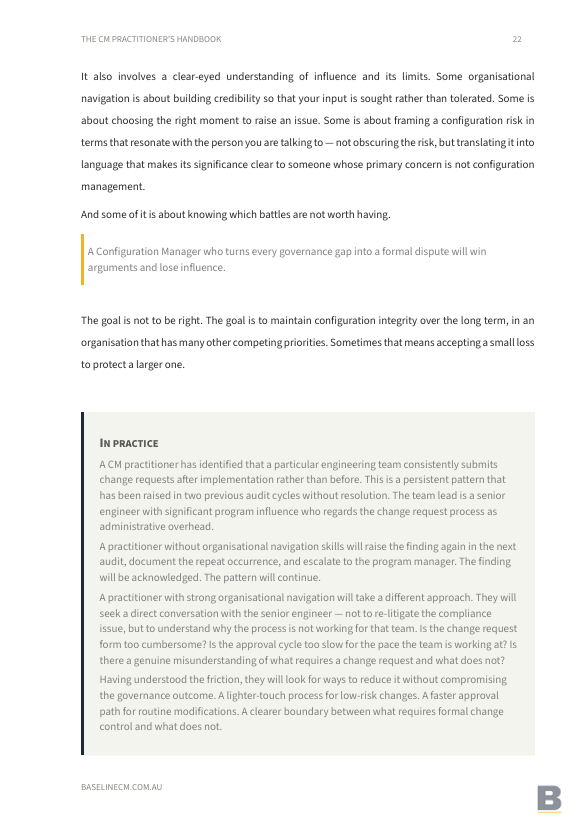
How to build influence without formal authority, communicate configuration risk to stakeholders who do not share your frame of reference, and navigate the political reality of complex programs without losing governance integrity.
-
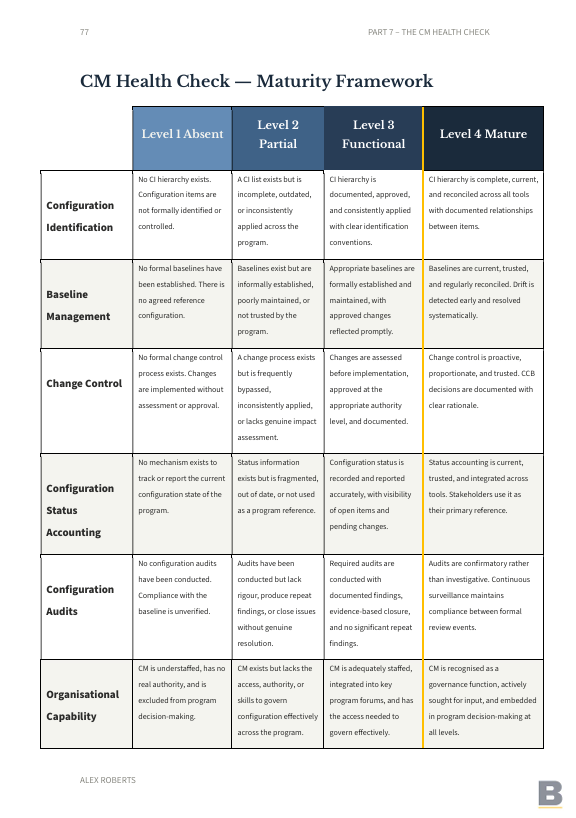
A structured six-domain framework for assessing CM maturity — with clear indicators of what good and poor practice look like in each domain. Usable as a self-assessment tool or the basis of an independent program review.
Who this is for
This guide is written with three readers in mind.
Practitioners early in their CM career who want to understand what the discipline actually involves beyond the processes they have been handed.
Mid-career practitioners who are competent at executing CM and are ready to develop the judgement, influence, and strategic awareness that distinguish effective practitioners from merely capable ones.
Engineers, project managers, and other professionals who have been handed CM responsibilities alongside their primary role and want a clear explanation of what they have actually been asked to do.
Details
90+ pages. PDF format. Instant download.
Written by Alex Roberts, Configuration Manager in the Australian defence industry and founder of Baseline Configuration Management.
Pricing
Single user licence. Organisational licences available — contact alex@baselinecm.com.au
A look inside
The CM Practitioner's Handbook is the first publication from Baseline Configuration Management. Independent. Practitioner-authored. No vendor agenda.